
Understanding Employment Lump Sums: Tax Implications and Key Considerations
Employment lump sums refer to one-off payments that employers make to employees outside their regular salary or wages. These payments can arise from various situations, such as redundancy, termination, settlement agreements, or retirement packages. The tax treatment of these lump sums depends on the type of payment. Here’s what you need to know about employment lump sums and how to handle them effectively for tax purposes.
1. Types of Employment Lump Sums
Employers issue lump sum payments in different circumstances, each with distinct tax rules:
- Redundancy Payments: When an employer makes an employee redundant, they may provide a lump sum. Up to £30,000 of this payment can be exempt from tax if it qualifies as a genuine redundancy payment.
- Termination Payments: When employment ends, termination payments often include compensation for loss of office or as part of a settlement. The first £30,000 of qualifying termination payments remains tax-free, while amounts exceeding this threshold become taxable.
- Retirement Lump Sums: Some pension schemes allow employees to withdraw a lump sum upon retirement. Depending on the pension scheme’s rules, part of the lump sum may be tax-free, with the remainder subject to Income Tax.
- Ex Gratia Payments: Employers may make payments as a goodwill gesture without a legal obligation. These payments may qualify for the £30,000 tax exemption if connected to loss of employment.
- Compensation for Breach of Contract: Employers pay compensation if they breach an employee’s contract. These payments are treated as earnings and taxed accordingly.
2. Tax Treatment of Employment Lump Sums
The tax treatment depends on the nature of the payment:
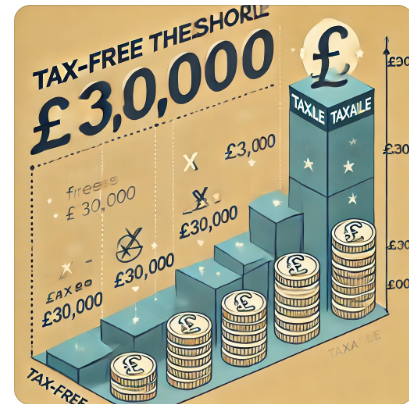
- Tax-Free Amount (Up to £30,000): For certain lump sums, the first £30,000 is tax-free, such as genuine redundancy or termination payments.
- Taxable Amount (Above £30,000): Any amount over £30,000 becomes taxable at the individual’s marginal tax rate (20%, 40%, or 45%).
- National Insurance Contributions (NICs): Tax-free lump sums generally remain exempt from NICs, but if payments exceed the £30,000 limit, they attract employer NICs.
3. Post-Employment Notice Pay (PENP)
When an employee leaves without working their full notice period, part of their termination payment may be treated as Post-Employment Notice Pay (PENP). This portion is always taxable and subject to NICs, regardless of the £30,000 exemption.


4. Lump Sums from Pensions
Employees can often take up to 25% of their pension pot as a tax-free lump sum when they retire. However, additional withdrawals from the pension pot will be taxed as income.
5. Settlement Agreements and Ex Gratia Payments
Settlement agreements commonly include lump sums to resolve employment disputes. If these payments compensate for loss of employment, the £30,000 tax-free exemption may apply. However, any amounts covering wages or benefits are fully taxable.
6. Payments In Lieu of Notice (PILON)
PILON occurs when employers pay employees a lump sum instead of requiring them to work their notice period. These payments are treated as earnings, making them fully taxable and subject to NICs, with no £30,000 exemption.
Key Takeaways:
- The first £30,000 of certain employment lump sums, like redundancy and termination payments, is tax-free.
- Any amount exceeding £30,000 is subject to Income Tax at the employee’s marginal rate.
- Payments such as PILON or PENP are always taxable and do not qualify for the £30,000 exemption.
- Properly document lump sums and their purpose to ensure accurate tax reporting.
By understanding the different types of employment lump sums and their tax treatment, you can better manage your tax liabilities and avoid unexpected costs. If you’re ever unsure about a payment’s tax implications, it’s always wise to seek professional advice to ensure compliance with HMRC rules.
For more specific scenarios and detailed advice, contact us for expert assistance.