
Listen to our podcast for a comprehensive discussion:
Listen to our podcast for a comprehensive discussion:
Overseas VAT Register: Everything You Need to Know
Entering the UK market looks exciting, but VAT obligations start sooner than many entrepreneurs expect. When your business lives outside the United Kingdom yet sells goods or services to UK customers, HM Revenue & Customs (HMRC) treats you as a non-established taxable person (NETP). Unlike domestic traders, you do not enjoy a £90,000 turnover cushion. You must register before you make your first taxable supply.
Who Counts as an Overseas Business?
You hold NETP (Non-Established Taxable Person) status when:
Your company has no fixed UK establishment.
The head office, directors, or key decision-makers sit abroad.
You will supply, or already supply, taxable goods or services in the UK.
Software firms in California, fashion boutiques in Milan, and wholesalers in Hong Kong all fall under this rule the moment they aim at UK customers.
Overseas VAT Register: When Do You Have to Register?
Domestic enterprises watch an annual turnover figure, but HMRC demands immediate action from NETPs:
Zero threshold: The first taxable sale, even a £1 ebook, triggers the duty to register.
30-day forecast rule: If you sign a contract today that will create UK sales within the next month, submit your VAT application right away, not when you invoice.
Exempt supplies: You can skip registration only when your entire UK output is VAT-exempt (for example, certain insurance services). Supplying both exempt and taxable items still forces you to register.
Smooth planning beats HMRC penalties, so build VAT registration into your launch timeline.
Overseas VAT Register: The Registration Process Step by Step
Create a Government Gateway account.
Complete form VAT1 online. Choose “Non-established taxable person” when prompted.
Provide evidence—articles of incorporation, proof of trading address, passport copies.
Wait for HMRC approval. Officers usually respond within 30 working days, but complex structures may take longer.
Receive your VAT registration certificate by secure email or post. The certificate shows your effective date of registration (EDR)—that date anchors every return, so store it safely.
Set up digital records compatible with Making Tax Digital (MTD). Cloud systems such as Xero, QuickBooks, or Sage handle UK VAT well.
Link a sterling bank account or currency service to pay VAT liabilities on time.
Because you act as a foreign entity, HMRC may ask for a security deposit. Keep funds ready to avoid delays.
Practical Example: US SaaS Firm Enters the UK Market
Scenario: On 1 June, ByteCloud Inc. (registered in Delaware) signs a £5,000 annual subscription with a London client. The service qualifies as taxable digital B2B supply.
1 June: Directors realise UK VAT applies.
By 30 June: They file form VAT1.
EDR: 1 June, because that is the point of contractual obligation.
1 July onward: ByteCloud invoices the client £5,000 + 20 % UK VAT, shows its new VAT number on the invoice, and records the sale in MTD-compatible software.
Quarter end: ByteCloud files its first return, pays £1,000 VAT, and starts reclaiming input tax on UK marketing expenses.
The early registration keeps ByteCloud compliant and protects its reputation with British buyers.
Ongoing VAT Responsibilities
Charge the correct rate. Most goods and many services attract 20 %, but check reduced or zero rates.
Issue VAT invoices within 30 days of supply.
File returns on time. NETPs choose quarterly or monthly cycles.
Pay VAT by the deadline. Use Faster Payments or CHAPS to meet the strict due dates.
Keep digital records for six years. HMRC can inspect records even though you operate abroad.
Notify changes fast. Update HMRC if your company address, bank, or contact details move.

Common Pitfalls and How to Avoid Them.
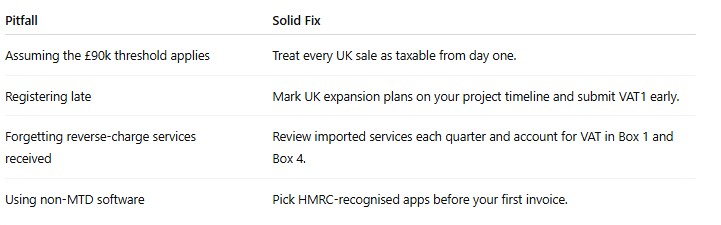
Consistent bookkeeping shuts the door on every listed error.
Conclusion
You control UK VAT success with three clear moves: register before sales start, maintain accurate digital records, and file returns without delay. These actions keep HMRC satisfied, improve cash-flow predictability, and build trust with UK partners. Handle VAT well, and you can focus on growth rather than penalties.
If you would like further assistance with this or anything else, please get in touch, contact us for expert assistance.